
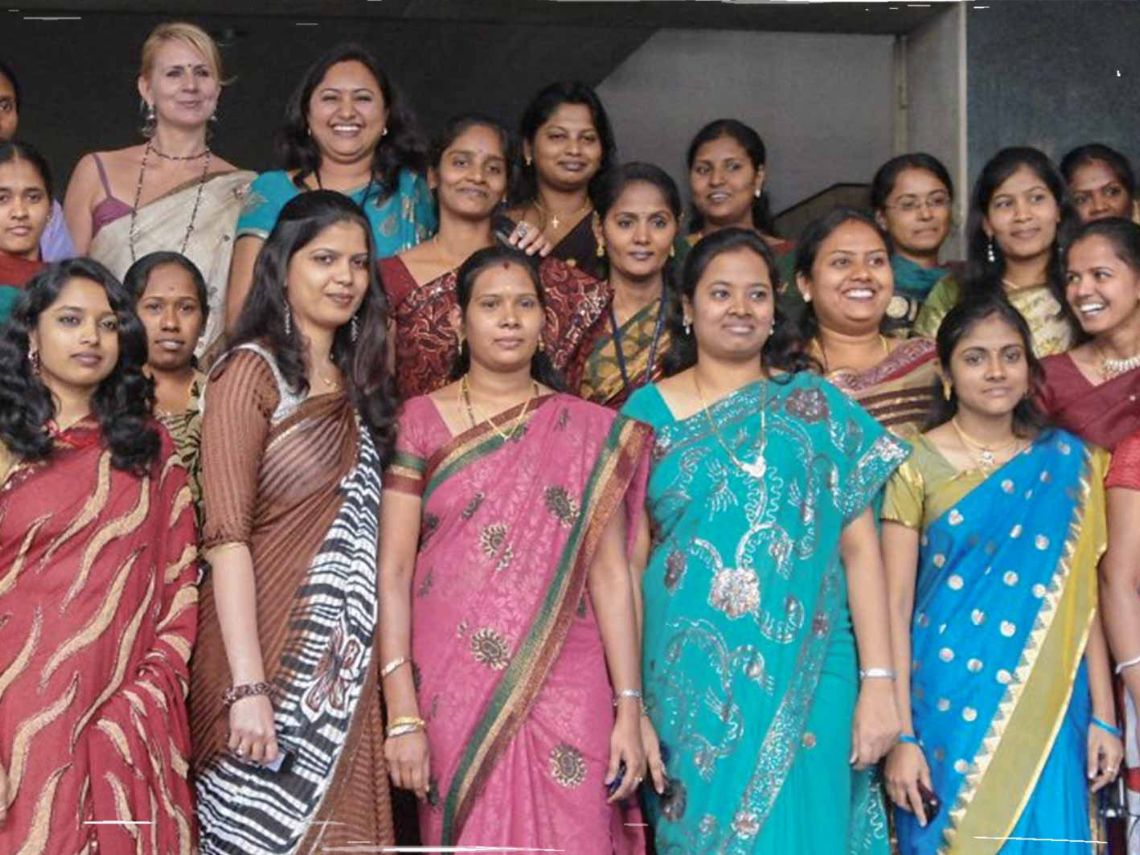
I still remember my first day at work in Bangalore like it was yesterday. My new job started – as they should for some reason – on a Monday and I had moved to the country with three suitcases and into a hotel only the day before. I spent that Sunday in the hotel room relaxing, mesmerised by Indian television and trying to darken up my fair skin with a self-tanning cream to try to appear less pasty white and blend in better at work. You see, I was the first ‘white girl’ hired by the company so I knew I was going to stand out a lot.
On Being Called Ma’am
The first woman I encountered that day was the really sweet receptionist who called me Ma’am from the get-go, which (as I get older) is not my favourite way to be addressed. It feels like an insult and on my first day at work I certainly didn’t understand AT ALL that it was simply a sign of respect. I thought she was insinuating that I was walking in looking tired or scrappy or OLD.
After a few moments I was taken into the CEOs office for a big meet-and-greet. I was part of the executive team and very happily I was not the only female. The smiles I received felt genuine and welcoming and warm. I expected that from my male colleagues because typically men do not feel threatened by women but I was genuinely pleased to feel it 100% from the ladies too. It was a nice change and I tell you…the smiles never faded.
But is working with Indian women all sunshine and rainbows?
No, not always. But not for the same reasons that I experienced when working in the U.S. or Europe. The negative reasons here are trivial, whereas back home they were reasons that affected productivity and happiness at work.
On Their Gentle Spirit
For me and probably most westerners, working with Indian women is a joy. First, there is something about the typical Indian woman’s personality that makes MOST of them have a gentle spirit at work. Don’t get me wrong, Indian women can and will get the job done just like or even better than any man but they tend to have a gentle spirit in my opinion. Now, that’s not always 100% true because I did work with one woman in Bangalore who was a bully, rude, yelled at her staff in front of others and didn’t play well with the rest of us executives – but this was one person out of hundreds whom I have worked with now so I’d prefer to think of her as the anomaly.
I’m really struggling with the right words to describe why I think women have this gentle spirit because I truly don’t want to offend my Indian sisters here. My gut says it comes from tradition and the somewhat subservient role that women have played in Indian society – where the men were the bread winners and the women were dependent and I believe obedient in the household and, in the past, not characteristically independent women of power. Given all of that, the new power women of India are still balancing the old traditions with their new status and therefore are an amazing mix of intelligence and skill combined with a keen ability to process situations and treat others with respect. Like I said, aside from the ‘anomaly’ I have yet to see a woman at work lose her cool or raise her voice like I’ve seen the men here do time and time again – in fact, a bit too frequently for my taste that’s for sure.
On Zero Back-Stabbing
In my experience, women at the same level or competing in a climb to the top in the U.S. and in Europe can be vicious. It’s often a hidden trait but it is there. Maybe because I was always a bit older than the other women I worked with that I didn’t feel the same need to prove to our boss that I was superior (plus I believe that crediting and praising others makes someone more of a leader than someone who tries to self-promote!). But the truth is that I have not been on an executive team with a single woman who did not make my life difficult or demonstrate some animosity or jealousy on some level EVER before moving to India. The change here is wonderful. Women are either simply more confident here or they haven’t adopted that overly competitive gene yet but it is a real treat to go to work and not worry if my colleague would be getting ‘up in my grill’ or not on any given day.
On Their Clothing
One struggle I have definitely had is with the clothing. With respect to Indian women at work, fashions are still very traditional. The breakdown goes something like this:
- 75% wear salwar kameez (the traditional Indian matching trousers/blouse/scarf combos)
- 20% wear a sari
- 5% wear international fashions
I have had trouble trying to sort out the role that someone has in the company if I don’t actually know them. From a purely physical standpoint, it’s hard to tell how high up someone is on the food chain simply by the clothing they wear. This can be tough on a westerner given that back home we have much clearer lines in wardrobe. The women in higher positions will dress up much more in a suit or fashionable business attire whereas the women starting out in their career or in entry-level positions are able to keep a more casual appearance. So how can I tell who is who when 95% of the women wear traditional Indian clothes to work? The simple answer is I can’t. This is India and in the workplace attire plays a small role at work but like so many other superficial things…it simply isn’t given that much weight. {UPDATE! Eventually I could sorta kinda tell by the jewellery, fabric, flowers in hair and shoes that were worn…}
Side Note: 100% of the Indian men I worked with wore international fashions. However, international fashions are unacceptable for most women in India because of the ever-present sexism and gender inequality sadly. They might be labelled as ‘easy’ (not necessarily by co-workers but more likely by neighbours) so most women won’t risk their reputation, or that of their family, just to wear the same cool jeans as the men.
On Hierarchy & Paying Respect
There is hierarchy in India that doesn’t exist in western cultures – with very clear lines. I am addressed as Ma’am or Madam by any female colleagues junior to me. It is a sign of respect that I am used to now but it still feels strange to me and I really wish they would just call me Angela. {UPDATE! After persisting a bit (especially to the receptionists who I greet several times a day going in and out) a few do use my first name but then they add Miss to it so I’m Miss Angela…}
Another thing with hierarchy is that there are typically no questions asked if someone senior asks someone more junior to do something, even if it is not typically their job. I personally don’t see this as a good thing but … this is India and that’s how they roll.
On Being Curious & Kind
In both companies I was the only non-Indian at the office (one had 2,000 employees) and I’ve been approached by my female colleagues more than in any other country. Indian women are as curious about me and my culture as I am about them and they go out of their way to ask questions and also to make me feel at home. They explain cultural differences and activities that are going on – or holidays – so I understand and appreciate what I am experiencing. And like I said before, the women always have a big, genuine smile.
Powerful female executives are on the rise in India and the workplace is becoming more and more accepting of women so rock on, India!!! As for me I’m going to have fun, learn as much as I can from them, and just enjoy the fact that I am fortunate enough to be surrounded every day by ‘power females’ in saris and traditional Indian attire, which I could never experience anywhere but India.
Don’t miss the flip side to this article: Working With Indian Men
Discover more from Angela Carson | Oversharing & Nomad Life in Asia
Subscribe to get the latest posts sent to your email.